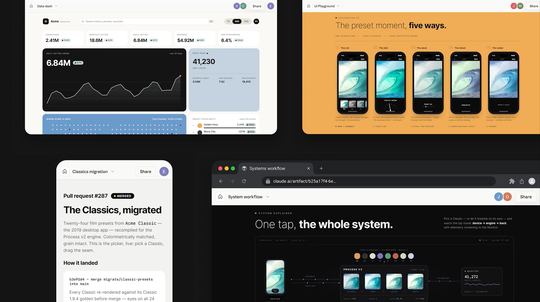
What surprised me here is not that Anthropic added a sharing layer to Claude Code. It’s that they’re leaning so hard into the idea that a live session should become a presentable artifact for other people. That’s a very specific bet: not just “let the model help me code,” but “let it narrate itself well enough that the rest of the team can watch.”



I can see the appeal immediately. If you’ve ever tried to explain a messy Claude Code session to a teammate, the gap is obvious: the person running it has context, everyone else gets a vague status update and maybe a pasted snippet. A generated page that tracks a PR walkthrough, a debug timeline, or a project dashboard could save a lot of hand-holding. That part makes sense.


What I’m less sold on is the implication that “visibility” alone solves coordination. A live page can make work feel legible without making it more correct. In fact, I’d worry about the opposite: once something is visualized cleanly, people trust it too much. A slick artifact can hide uncertainty, dead ends, or model wobble better than a chat log ever would. If I were using this, I’d treat it as a communication surface, not a source of truth.


The collaboration angle is the more interesting twist. The article says the artifact can be shared privately inside an organization, and later edited together in Team/Enterprise. That starts to look less like a report and more like a shared workspace. I think that’s where this could actually become sticky for teams that already live in Claude Code: one person kicks off the work, others can inspect and steer without needing to spelunk through terminal output or ask for a recap every ten minutes.




Still, I’m a little cautious about how much of this is genuinely new versus just Anthropic giving a name to a pattern people were already duct-taping together with docs, links, and screenshots. The private-link, versioned, self-contained story is nice, but it also sounds like the kind of thing that only feels seamless once you’re already deep in the Claude ecosystem.



If I had to test it, I’d try it on exactly the kind of ugly work that usually resists being shared: incident response, refactors that span several files, or an agent-driven investigation where the team keeps asking “where are we now?” That’s where a living artifact could earn its keep. For a trivial task, it’s probably overkill.







Reference: 「Claude Code」がアーティファクトに対応 ~セッションを“見える化”してチーム共有【7月15日追記】/アーティファクトを共有したり、共同編集することも可能に