If you build with Claude, this is one of those stories that makes the model progress feel less abstract and a lot more operational. Epoch AI is pointing to a sharp jump in serious CVE disclosures right after Anthropic said Claude Mythos Preview could autonomously find software vulnerabilities, and that’s exactly the kind of downstream effect developers should be watching.



What strikes me is that this is a rare moment where a frontier model announcement seems to show up in a measurable real-world security signal almost immediately. I think that matters more than the usual benchmark chatter. A model that can help discover vulnerabilities is not just another coding assistant feature; it changes the economics of red teaming, patching, and maybe even how fast bad actors can move if the same capability leaks outward.

At the same time, I’d be careful not to oversell the graph. Public CVEs are only the visible layer, and Epoch says as much. If Anthropic’s partners found a lot of issues privately before disclosure, then the public spike may be partly a bookkeeping effect. Still, I don’t think that makes the story weaker. If anything, it suggests frontier models are already creating pressure on the security pipeline whether or not the public sees every finding.

For Claude and Claude Code users, the practical takeaway is pretty simple: treat these systems as dual-use tools, not just productivity boosters. I’d be curious whether the strongest near-term value is in defensive workflows inside larger orgs — code review, dependency scanning, exploit simulation, patch validation — rather than flashy autonomous hacking demos. That’s the boring version, but it’s probably the one that lands.

The bigger picture is that AI-assisted security is moving fast enough to leave a statistical footprint. That’s the part worth paying attention to, not just the model name attached to it.
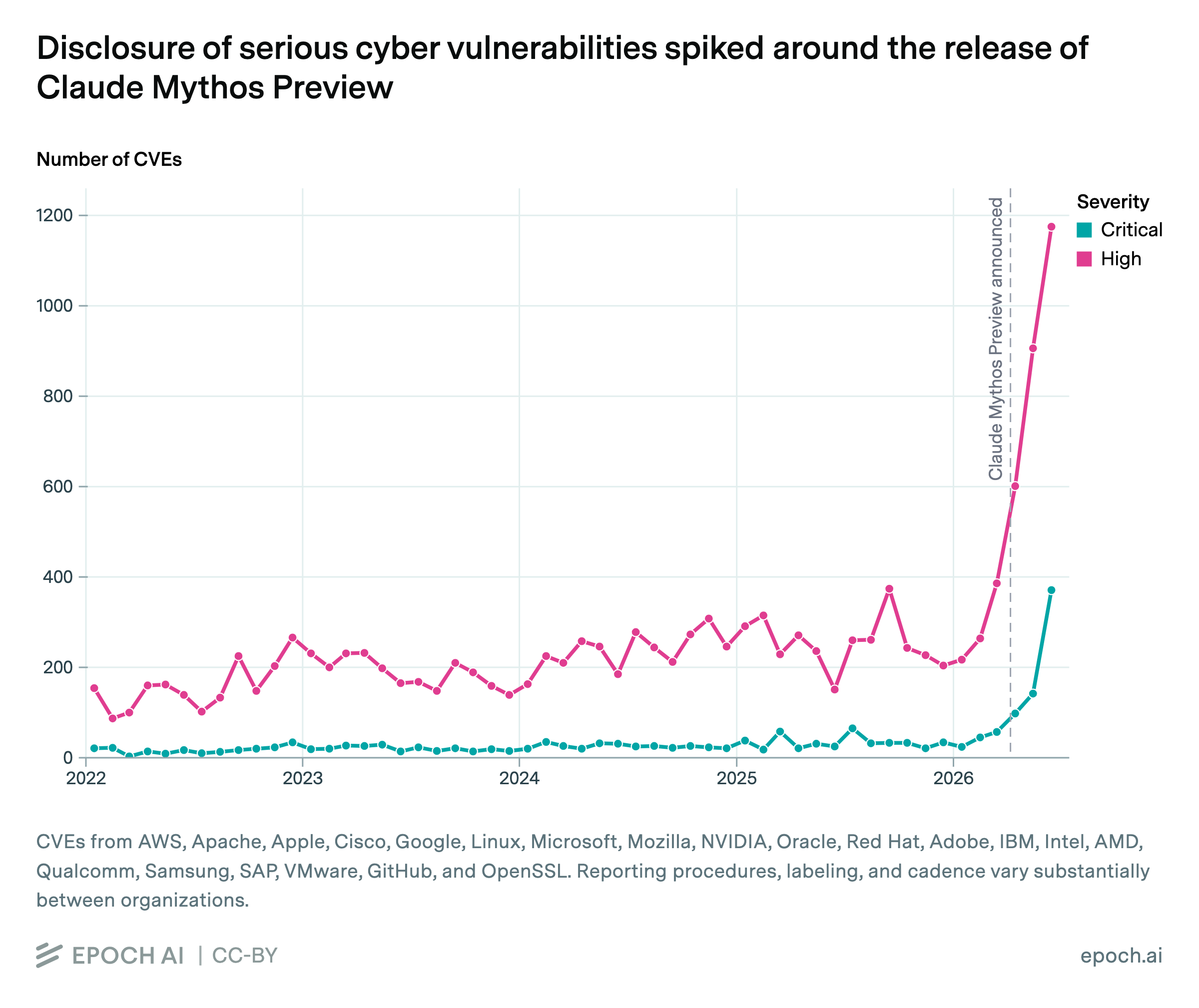
Reference: Disclosure of serious cyber vulnerabilities spiked around the release of Claude Mythos Preview