What surprised me here is not that Anthropic built a security plugin. It’s that they’re packaging a multi-agent scan into Claude Code and making it feel like just another terminal command. That’s a pretty aggressive move, and honestly, it makes more sense than yet another “AI security assistant” sitting in a separate web app that nobody will actually wire into their workflow.


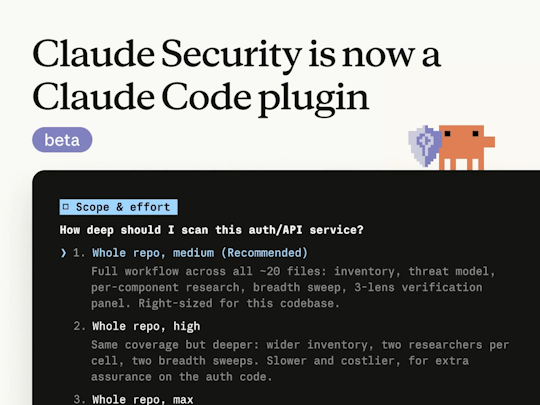
The part I’d want to try first is the change-only scan. Full-repo security scans are nice in theory, but in real projects they often become noisy and expensive fast. A tool that can look at a PR diff, build a threat model, and then have a second agent independently check the findings is much closer to something developers might run before merging. That “independent verification” piece is the only part here that sounds like it might actually reduce the usual hallucination problem instead of just rebranding it.


I’m a bit skeptical of the framing, though. “Multiple agents” sounds impressive, but unless Anthropic is being very disciplined about what counts as a vulnerability, this could easily become a confidence machine that produces polished reports with a lot of false positives. The article says patches are only proposed, not auto-applied, which is good. That restraint matters. Security tooling that quietly edits code for you is where things get dangerous quickly.


The other interesting detail is the split between the plugin and the managed enterprise product. That tells me Anthropic knows this is partly a workflow product and partly an ops product. The plugin covers repos the managed service won’t reach, like GitLab or Bitbucket-hosted code, which is pragmatic. But it also hints at the real strategy: get developers used to Claude as the place where security review happens, then sell the persistent monitoring layer to teams later. I think that’s probably the more important story than the plugin itself.





One thing I don’t know from the article is how good the detection actually is. The announcement reads like a capability list, not a benchmark. I’d want to see what kinds of issues it catches well, where it misses, and whether the “independent” agent is meaningfully different from the first one or just another pass with different wording. Without that, it’s hard to tell whether this is genuinely useful or just a very well-presented demo.




Still, as a Claude Code extension, this feels directionally right. Security checks are one of the few places where an LLM assistant can be tolerated being a little slower and a little overcautious, because the cost of missing something is real. If Anthropic can keep the noise under control, this might become one of the more credible “agentic” use cases they’ve shipped.
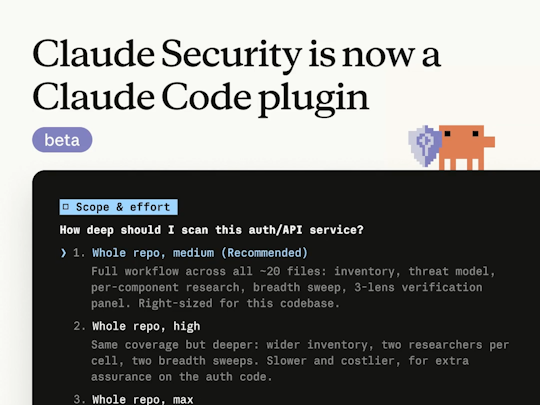







Reference: 「Claude Code」プラグイン「Claude Security」がベータ公開 ~複数エージェントが脆弱性を指摘/検証・修正案の提示までを行うセキュリティ支援ツール